
History
The Many Portraits of Betty Crocker
How a fictional homemaker became one of the most recognizable figures in American food culture.
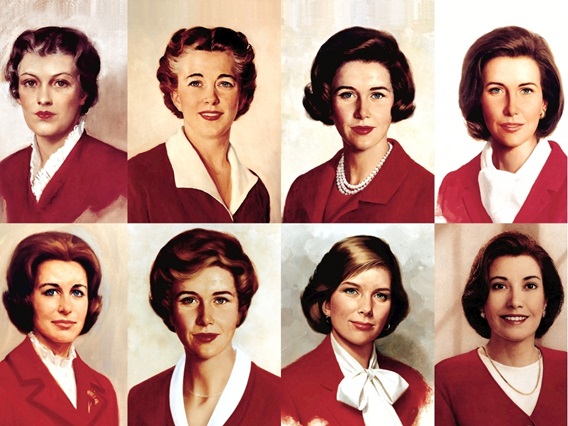
In honor of Women’s History Month, let’s take a look at one of the most influential women in American kitchens – even if she isn’t technically real.
For more than a century, Betty Crocker has served as the matriarch of General Mills, offering recipes, household guidance and reassurance to generations of home cooks. But her story begins not in a kitchen, but in a mailroom.
In 1921, Gold Medal Flour ran a puzzle advertisement in The Saturday Evening Post, inviting readers to mail in their completed puzzles for a free pincushion. What came back wasn’t just puzzle entries, but thousands of handwritten baking questions from home cooks seeking reliable advice. Faced with the need to respond personally and consistently, Washburn-Crosby, General Mills’ predecessor company, created a fictional yet approachable female persona to sign each reply.
They chose the name "Betty" for its warmth and friendliness, and "Crocker" in honor of a recently retired company director. What began as a practical signature to consumer correspondence quickly took on a life of its own.
Over time, Betty grew into something much more than a name on a letter – she became a trusted presence in American households. Over the decades, Betty’s look has evolved repeatedly, reflecting changing expectations of women, shifts in American culture and the many ways homemaking itself has been redefined.

Fifteen years after her 1921 debut, Betty Crocker received her first official portrait. Commissioned in 1936 from artist Neysa McMein, the painting marked the first time the brand gave Betty a consistent visual identity that made her more tangible to consumers. Prior to this moment, Betty’s image had been inconsistent, often depicted as a generic drawing or represented by stock photos of anonymous women.
McMein used loose brushstrokes to create a bust-length image of Betty wearing a red sweater or blazer over a white blouse. Betty’s gaze meets the viewer directly. While she may not appear overtly friendly, she projects something just as important – reliability and trust.

McMein didn’t invent Betty’s look in isolation. The artist’s version of Betty Crocker was the result of several studies and sketches, as well as quality time spent with Marjorie Husted, head of General Mills’ Home Service Department that managed the Betty Crocker brand. The result was a portrait that felt authentic and grounded in the real work Betty represented.
For more than two decades, McMein’s portrait shaped how Americans saw Betty Crocker. She became a trusted source for dependable recipes, practical household advice and thoughtful guidance.

As World War II brought profound changes to daily life, Betty had already become one of the most recognized women in the country – widely known as the "First Lady of Food" – and was called upon to help Americans navigate a new reality.
With busier days and tighter resources, Betty Crocker stepped in to serve as a wartime companion. She developed new recipes and products to accommodate smaller budgets and limited ingredients, helping homemakers make the most of rationed foods. At the request of the U.S. Office of War Information, Betty Crocker broadcast a radio program and newsletter called, Our Nation’s Rations which shared resourceful recipes, household tips and reassurance for families navigating uncertainty.

The response was so strong that her guidance was compiled into a booklet titled, Your Share. Distributed for free to nearly seven million Americans, it included 52 menus, 226 recipes and more than 360 wartime tips covering everything from grocery shopping and cooking to entertaining and etiquette. Recipes emphasized ways to stretch meat and dairy rations and suggested common pantry substitutes for scarce ingredients like sugar.
Throughout the challenges of wartime, Betty Crocker offered more than just recipes – she offered solidarity. By addressing everyday problems with simple, achievable solutions, she reminded Americans they were not alone.
By 1955, General Mills decided Betty’s appearance needed a refresh. The steady, resourceful Betty who had guided households through wartime no longer reflected the spirit of an era defined by growth, optimism and possibilities.
To find a new look, General Mills invited six well-known artists – including Norman Rockwell – to submit their interpretations of Betty Crocker. Nearly 1,600 American women from varying backgrounds were then asked to evaluate the submissions and select the new face of Betty.

The winning portrait, painted by artist Hilda Taylor, presented Betty with a sincere smile and approachable warmth that resonated strongly with mid-century homemakers.
Betty Crocker continued to evolve alongside the women she represented. Over the next forty years, five additional official portraits were created, each reflecting shifts in fashion, culture and consumer tastes.

Magazine illustrator Joe Bowler painted Betty in both 1965 and 1969. His portraits updated her wardrobe to be suitable for the home, as well as for social and professional settings.

That trend continued in 1972 when Minnesotan artist Jerome Ryan introduced a more assertive Betty – complete with a confident power suit.

The 1980 version of Betty was designed by a Manhattan-based design team, while artist Harriet Pertchik produced the penultimate official portrait in 1986.

Each iteration subtly adapted Betty’s image to reflect the changing identity of the modern homemaker.
In 1996, Betty Crocker celebrated her 75th anniversary with a project that brought the fictional icon closer to reality than ever before. To commemorate the event, the brand launched an essay competition titled “The Spirit of Betty Crocker,” inviting women across North America to share what Betty meant to them.
Open to women ages 18 to 118, the contest drew nearly 5,000 submissions. Seventy-five winners were selected, and each woman sat for a photographic portrait. Those images were combined into a single composite face representing all 75 participants.

International artist John Stuart Ingle then used the composite as the foundation for Betty Crocker’s eighth – and final – official portrait.

For the first time, Betty Crocker’s face was literally built from the women she had served for decades.
Although Betty Crocker’s appearance has evolved many times, the foundation of the brand has remained the same: to support and serve the everyday homemaker. While the 1996 portrait marked the last official image of Betty, the brand continues to celebrate memorable moments in a way that reflects her legacy as the “First Lady of Food.” For her 100th birthday, the “Call Me Betty” campaign invited consumers to share their own recipes for a chance to appear on the iconic red box. The milestone also brought the release of the 13th edition of the Betty Crocker Cookbook, which by 2016 had sold more than 75 million copies worldwide.
Although Betty Crocker is not a real woman, she represents the resilience, creativity and experiences of generations of real women. And that is certainly something worth celebrating during Women’s History Month.
To explore more, discover new recipes, and see what Betty has been cooking up, visit Betty Crocker.com.